
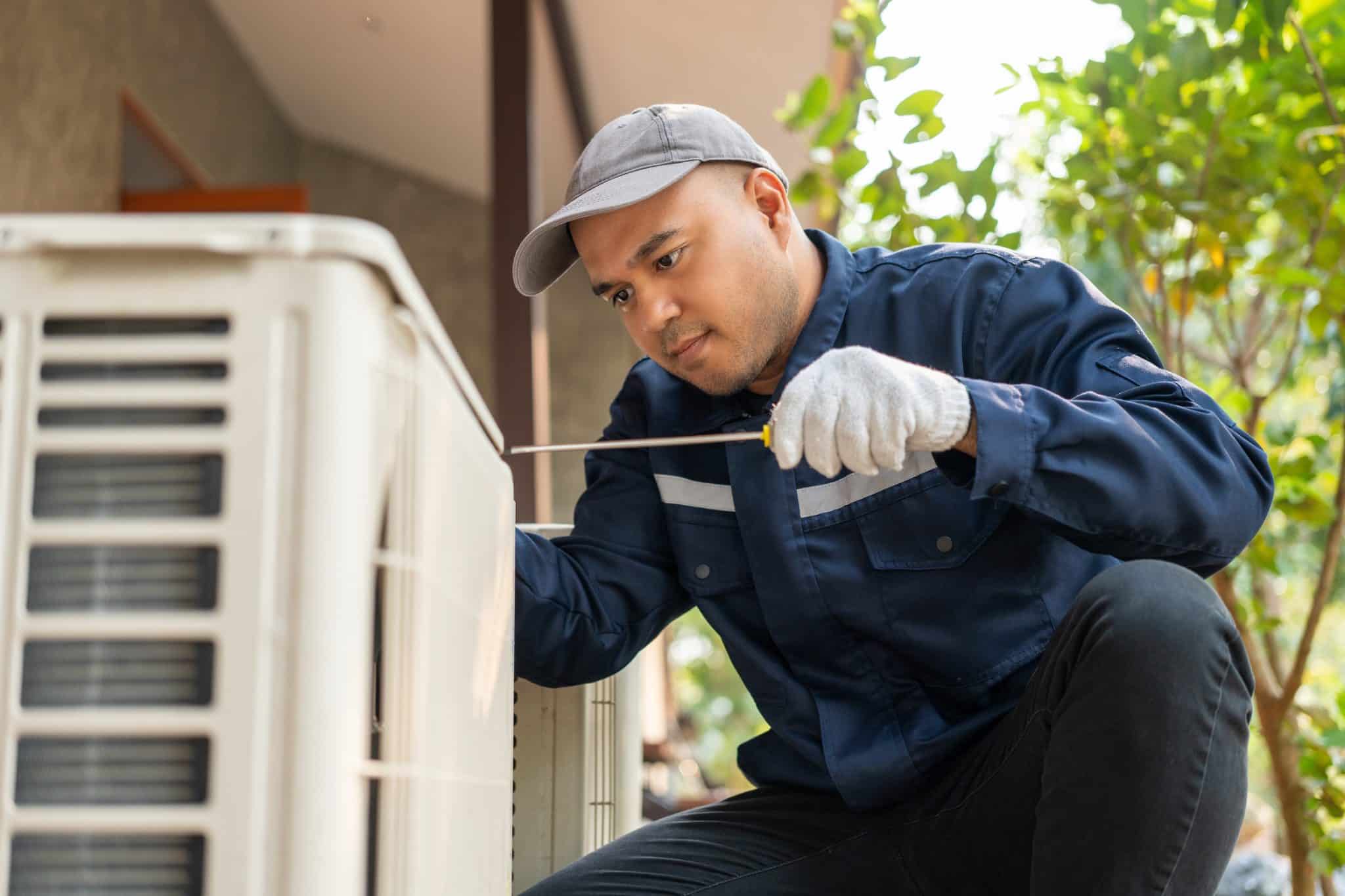
Your air conditioner is fifteen years old. It still cools the house. Nobody has called it a problem yet. So the question sitting in the back of your mind every summer is whether you are being smart by keeping it, or whether you are quietly spending more to run an aging system than a new one would cost you to own.
That is a money question, not a comfort question, and it deserves a real answer. The good news for Longmont homeowners is that Colorado is unusually kind to air conditioners. The complication is that the usual advice you find online was written for a very different climate.
At a Glance
- Colorado runs its air conditioners far less than southern states, which changes the lifespan math in your favor
- The federal government uses a 24-year analysis period for cooling equipment in northern states, but that is an economic assumption, not a warranty
- Age alone is not a reason to replace. Repair frequency, repair cost, and refrigerant type are the real decision drivers
- Hail is the Colorado wild card, though moderate fin damage matters far less than most homeowners assume
- Several popular replace-now warning signs, especially indoor humidity, simply do not apply along the Front Range
Why Colorado Air Conditioners Have an Easier Life
Lifespan estimates travel around the internet without any climate attached to them, which is how a homeowner in Longmont ends up reading advice written for Houston.
The cleanest way to compare workload between climates is cooling degree days, a NOAA measure of how much cooling a location actually demands over a year. Longmont records roughly 657 cooling degree days annually. Denver International sits near 850. Phoenix Sky Harbor records about 4,765. Houston is above 3,200.
Read that again. A Phoenix air conditioner does something on the order of seven times the annual cooling work that a Longmont unit does.
Boulder logs essentially zero cooling demand from November through March. Your system’s entire working year is compressed into June, July, and August, and even then, it is cycling through cool nights rather than grinding through 95-degree darkness. Less annual runtime is the single biggest reason a well-maintained Colorado system can stay in service comfortably past the point where the same equipment would have failed in Arizona.
The U.S. Department of Energy’s Federal Energy Management Program uses a 24-year lifetime for northern states in its life-cycle cost analysis of residential central air conditioners, compared with 18 years for hot and humid regions. That figure is an economic planning assumption rather than a promise about your specific unit, but the direction it points is real, and it favors Colorado.
What the Age of YourAC Actually Tells You
ENERGY STAR’s guidance is straightforward: if your air conditioner is more than 10 years old, it is worth considering a replacement with a high-efficiency unit. The Department of Energy’s consumer guide places the stronger candidate threshold at 15 years.
Neither agency says a 12-year-old unit is broken. What they are describing is a window where the efficiency gap between what you own and what you could buy becomes wide enough to matter financially.
Here is a more useful way to think about it:
- Under 10 years: Repair almost always wins. Replacement rarely pencils out unless the compressor fails outright.
- 10 to 15 years: The decision zone. Efficiency gains are real and worth pricing, but a single repair does not justify replacement on its own.
- 15 to 20 years: Every significant repair deserves a replacement quote alongside it for comparison.
- Past 20 years: Still cooling is a credit to the installer and to Colorado’s climate. Plan the replacement on your schedule rather than during a July failure.
Does an Older AC Really Cost More to Run?
Efficiency has improved, and the numbers are documented. Under federal standards, split-system central air conditioners manufactured for the North region, which includes Colorado, must meet a minimum of 13.4 SEER2. ENERGY STAR qualified equipment reaches 15.2 SEER2, and the best available equipment reaches 23.5 SEER2. ENERGY STAR states that a correctly installed high-efficiency system can save up to 20 percent on heating and cooling costs.
One thing to be careful about: you will find claims online that an air conditioner loses a specific percentage of efficiency every year. No federal source publishes that figure, and we are not going to repeat it. What the evidence does support is that the gap between a decade-old unit and current equipment is meaningful, and that the gap is worth quantifying against your own utility bills rather than a generic percentage.
The honest caveat for Colorado is that a 20 percent reduction applies to a smaller cooling bill here than it would in Texas. Efficiency upgrades pay back more slowly in a low cooling demand climate. That is not an argument against replacement. It is an argument for making the decision with real numbers instead of urgency.
The Warning Signs That Actually Apply Here
Most replace-now checklists list rising indoor humidity as a top signal that your system is failing. Along the Front Range, that advice is close to useless. Denver’s afternoon relative humidity runs in the mid-30s through summer. You are not going to diagnose an aging air conditioner by watching for muggy air in a semi-arid climate.
The signals worth tracking in Colorado are different:
- Repairs are clustering. One repair in five years is maintenance. Two or three in two seasons is a system telling you something. If you are calling for AC repair more than once a season, track it.
- The unit runs longer to reach the same temperature. Compare against your own history, not a neighbor’s.
- Cooling is uneven between floors in a way that was not true five years ago.
- The system struggles specifically on hot afternoons rather than failing outright, which often points to declining capacity.
- Your summer electric bills are climbing while your thermostat settings and occupancy have not changed.
How Do I Weigh a Repair Against a Replacement?
You will see repair-cost thresholds quoted online, usually somewhere between 30 and 50 percent of replacement cost. Those rules of thumb contradict each other across sources, and none of them accounts for how long you plan to stay in the home.
A more reliable approach is to ask three questions together. How much is this repair? How many more seasons does the technician realistically expect from the rest of the system? And what does a new system cost to own, including financing, against what the old one costs to run?
A 900-dollar repair on a system with eight good years left is a fine investment. The same repair on a system a technician expects to fail within two seasons is money you will spend twice.
Hail: The Colorado Factor Nobody Writes About
Search any of the major lifespan articles, and you will not find the word hail. For a Longmont homeowner, that is a significant omission.
NOAA’s National Severe Storms Laboratory identifies Hail Alley where Nebraska, Colorado, and Wyoming meet, averaging seven to nine hail days each year, and the Front Range specifically runs higher. The Colorado Division of Insurance calls hail the number one cost driver of insurance in the state, accounting for 26 to 54 percent of a homeowner’s premium.
Your condenser sits outside, unprotected, through all of it.
Now here is the part that runs against what most contractors will tell you. Hail damage to condenser fins is usually less catastrophic than it looks. Engineering testing on residential split systems found that performance dropped appreciably only once, roughly 60 percent of the fin area was flattened, and that combing the fins back out restored capacity to within 1 percent and efficiency to within 6 percent of the original. Further analysis found that around 41 percent fin flattening produced only a 2 to 5 percent efficiency loss, while 100 percent flattening cost 23 to 27 percent of capacity.
The practical takeaway: a dinged-up condenser is often a combing job, not a replacement. If a contractor uses cosmetic hail damage as the reason you need a new system, get a second opinion. If the damage is severe and widespread, that is a different conversation, and it is one worth having with your insurer before you spend anything.
What About the Refrigerant Situation?
This is where a lot of the content online went out of date in 2026, and where homeowners are being pressured with bad information.
New residential systems no longer use R-410A. Manufacture and import of equipment using higher-GWP refrigerant ended January 1, 2025, which is why new units now use R-454B or R-32.
What that does not mean is that your existing system is on a clock. The EPA states plainly that there are no requirements to stop using equipment currently in use, and existing R-410A systems can be serviced indefinitely. A rule finalized in May 2026 also removed the installation deadline for R-410A systems whose components were manufactured before 2025, and expressly declined to restrict replacing a failed condensing unit on its own.
The real pressure is on supply, not legality. R-410A production is capped at 60 percent of baseline through 2028, stepping down to 30 percent in 2029 and 15 percent in 2036. As the cap tightens, refrigerant for older systems gets more expensive. That is a legitimate factor in a repair-versus-replace decision on a system with a known leak. It is not a reason to replace a sound system this month.
Getting the Replacement Right When the Time Comes
If you do land on replacement, sizing matters more than brand. The Department of Energy is direct about this, noting that the square-feet-per-ton rule of thumb “fails to take into account local climate and the efficiency of a house” and that a contractor should perform a Manual J load calculation instead. An oversized system short-cycles, wears faster, and costs more to buy.
An oversized unit is a particular risk in Colorado, where a contractor accustomed to sizing for a harsher cooling climate can easily overshoot a Front Range home’s actual load.
Whichever way the decision goes, the cheapest years you will get out of any system come from keeping up with it. Annual service on an AC maintenance plan catches the small failures that turn into the repair clusters described above, and it matters more on a system you intend to keep another five years than on one you are about to replace.
The Short Version
- Under 10 years: repair
- 10 to 15 years: price both, decide on numbers
- 15 to 20 years: get a replacement quote alongside every significant repair
- Past 20 years: plan the replacement before it plans itself
- Hail damage: get it assessed before assuming the worst
- R-410A: a supply issue on leaking systems, not a deadline on working ones
Colorado gives your air conditioner an easier life than almost anywhere in the country. That is worth knowing, because it means you probably have more time than the internet is telling you, and more reason to make this decision on math rather than pressure.
Talk to SAC Mechanical Before You Decide
If your system is in the decision zone, a straight assessment beats a guess. SAC Mechanical has served Longmont and the surrounding Colorado communities since 1982, and we will tell you when a repair is the smarter choice. Schedule an AC assessment or call (303) 825-9483 to talk it through.